
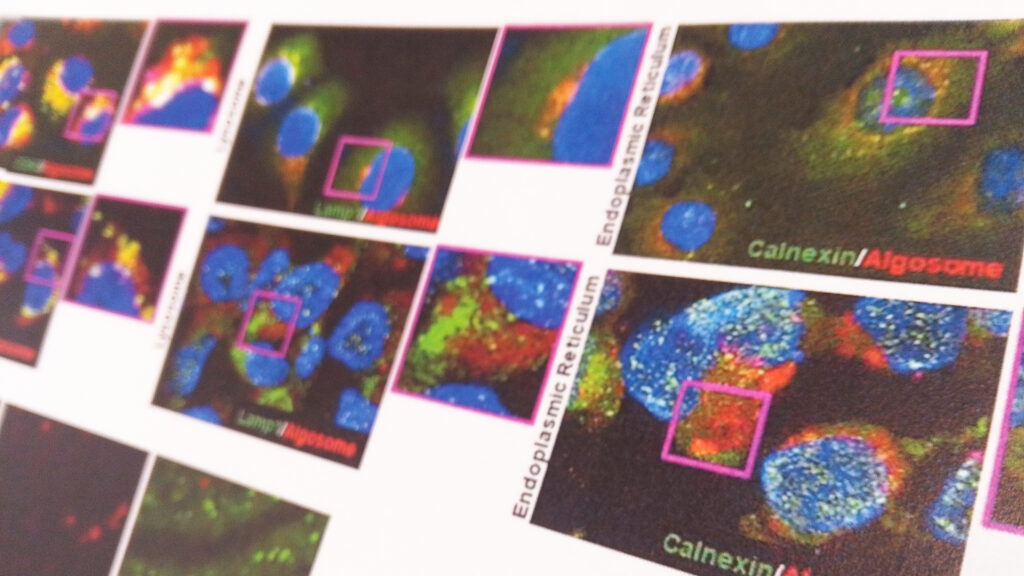
The scientific article “Extracellular vesicles from the microalga Tetraselmis chuii are biocompatible and exhibit unique bone tropism along with antioxidant and anti-inflammatory properties”, recently published in Nature’s “Communications Biology”, leverages results from the BOW project.
The study investigated Microalgal extracellular vesicles, named nanoalgosomes, from the marine microalgae Tetraselmis chuii using an improved production method. The research examined how nanoalgosomes are absorbed by cells and their distribution within the body. They were found to possess antioxidant and anti-inflammatory properties. Overall, the study indicates that nanoalgosomes are safe, biocompatible and innate bioactive effectors with unique bone tropism. The findings also suggest that nanoalgosomes have significant potential for future therapeutic applications.
The study received contributions from numerous partners of the BOW project, as well as other organizations. These include the Consiglio Nazionale delle Ricerche (encompassing the Institute for Research and Biomedical Innovation, the Institute of Biosciences and BioResources, and the Institute of Biophysics), the Max Planck Institute for Polymer Research, the University of Brescia, the Center for Colloid and Surface Science (CSGI), and Atlantic Technological University.
Many findings from the BOW project have been used in this study, but also from VES4US, another H2020 project that could be understood as a predecessor of BOW. During VES4US, a new, non-traditional path was taken. In BOW, it has become evident that there are no limits to what can be achieved with biogenic and green cell-derived particles. The journey relies on three core principles learned by the BOW team:
- The extracellular membrane, so similar to the cell membrane of any organism.
- Cell-to-cell and even inter-organism communication.
- And the potential to go beyond conventional boundaries with the right questions and multidisciplinary tools.
You can find the publication here: https://www.nature.com/articles/s42003-024-06612-9.
And all publications from BOW project here: https://www.bowproject.eu/Results/.

